
 English
 русский
 Español
 عربى
عربى
 Home / News / Industry News / China Coaxial Cable Sourcing Guide: Types, Standards, and Supplier Tips
Industry News
China Coaxial Cable Sourcing Guide: Types, Standards, and Supplier Tips
2026-08-14
Content
- 1 Why China Has Become a Practical Source for Coaxial Cable
- 2 Coaxial Cable Families You Will Encounter in the Chinese Market
- 3 What to Verify Before You Place a Coaxial Cable Order
- 4 Certifications That Separate a Cable Factory from a Trading Company
- 5 Where China-Made Coaxial Cable Is Actually Used
- 6 Common Incoming Inspection Issues and a Practical Procurement Checklist
- 7 Frequently Asked Questions
Why China Has Become a Practical Source for Coaxial Cable
When a sourcing engineer sends an inquiry for coaxial cable to a Chinese factory, the first reply usually asks for three numbers: characteristic impedance, maximum operating frequency, and continuous temperature rating. Those three values determine which production line the cable runs on, which dielectric material is stocked, and which test fixtures the quality lab needs to prepare.
The conclusion up front: Chinese manufacturers can supply both commodity RG-series coaxial cable and high-performance PTFE-dielectric RF cable, but the difference between a smooth project and a costly rework rarely depends on geography. It depends on how precisely you define your requirements and how thoroughly you verify the supplier.
China's coaxial cable industry feeds global telecom networks, automotive electronics, aerospace platforms, and industrial automation lines. Many medium and large factories have vertically integrated production: copper drawing, conductor plating, fluoroplastic extrusion, braiding, and RF testing under one roof. Factories in Jiangsu, Guangdong, and Zhejiang account for a large share of specialty RF cable output, which means buyers can usually find a manufacturer that matches both their technical profile and their order volume. That structure keeps lead times short and gives buyers a single point of accountability for quality.
Coaxial Cable Families You Will Encounter in the Chinese Market
Most Chinese cable factories classify coaxial production into two families: RG-series cables for general RF interconnection and SFF-series cables for high-temperature or low-loss transmission paths. Within those families, four designs cover the majority of industrial and telecom inquiries.
RG-Series Cables
- RG178 is a miniature 50 Ω cable with a PTFE dielectric and a silver-plated copper conductor. Its small outer diameter makes it a natural fit for dense PCB layouts and internal jumpers. A common choice is the RG178 high-temperature coaxial RF cable
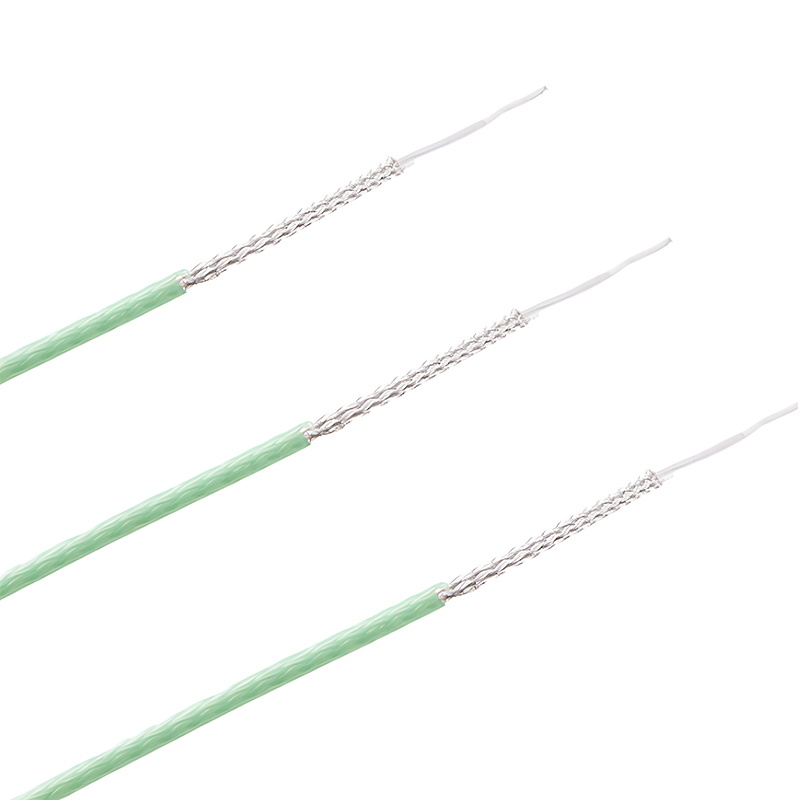 Custom RG-178 High-Temperature Coaxial (RF) Cable Manufacturer, Supplier - JiangJiangsu Silver & Tin Thread Hi-temperature Wire and Cables Co., Ltd. is China custom RG-178 High-Temperature Coaxial (RF) Cable suppliers...View Product → used in compact radio modules.
 - RG316 uses a stranded silver-plated copper center conductor, which gives it noticeably better flex life than solid-conductor designs. It stays at 50 Ω and is rated up to about 200 °C, so avionics and test equipment designers frequently specify it.
- RG303 is a dual-shielded variant with a PTFE dielectric, selected when electromagnetic interference is a concern in tight chassis layouts.
SFF-Series Cables
The SFF family uses FEP or PTFE dielectrics and is engineered for continuous exposure to elevated temperature. These cables show up in power amplifier cabinets, radar assemblies, and industrial sensors. The SFF high-temperature coaxial RF cable is a common choice when a run must keep stable impedance while routed near heat sources.
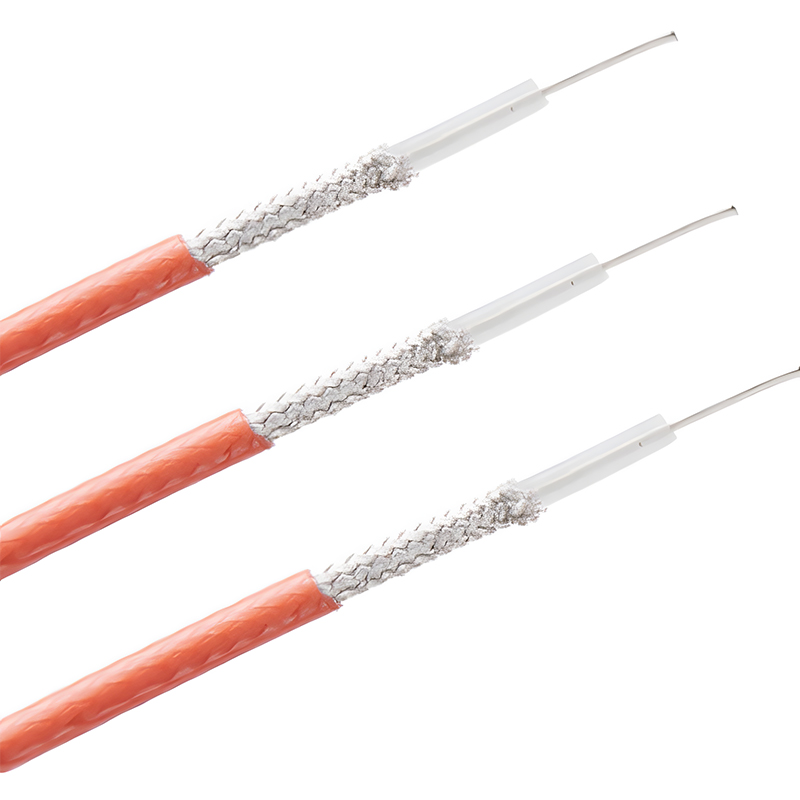 Custom SFF High-Temperature Coaxial (RF) Cable Manufacturer, Supplier - Jiangsu Jiangsu Silver & Tin Thread Hi-temperature Wire and Cables Co., Ltd. is China custom SFF High-Temperature Coaxial (RF) Cable suppliers an...View Product →
| Cable Family | Impedance | Dielectric | Continuous Temp. | Typical Priority |
|---|---|---|---|---|
| RG178 | 50 Ω | PTFE | up to 200 °C | Miniature size |
| RG316 | 50 Ω | PTFE | up to 200 °C | Flex life |
| RG303 | 50 Ω | PTFE | up to 200 °C | Dual shielding |
| SFF / SF46F | 50 Ω | FEP / PTFE | 200 °C and above | High-temperature stability |
What to Verify Before You Place a Coaxial Cable Order
Field failures in coaxial systems are usually traceable to a specification that was assumed instead of verified. These four checks catch most of them.
Characteristic Impedance and VSWR
Confirm the nominal impedance before anything else. A 50 Ω system does not accept a 75 Ω cable without adding return loss and ripple across the passband. The connectors must also match the cable's dielectric family, otherwise the transition point becomes the weakest link.
Temperature Rating and the Real Heat Profile
Ask for the continuous rating, not just the maximum survival temperature. PTFE-based constructions such as the RG316 high-temperature coaxial RF cable carry a 200 °C continuous rating, with short-term peaks allowed at higher values. The physical characteristics of high-temperature PTFE wires explain why the dielectric holds its electrical performance so well under heat.
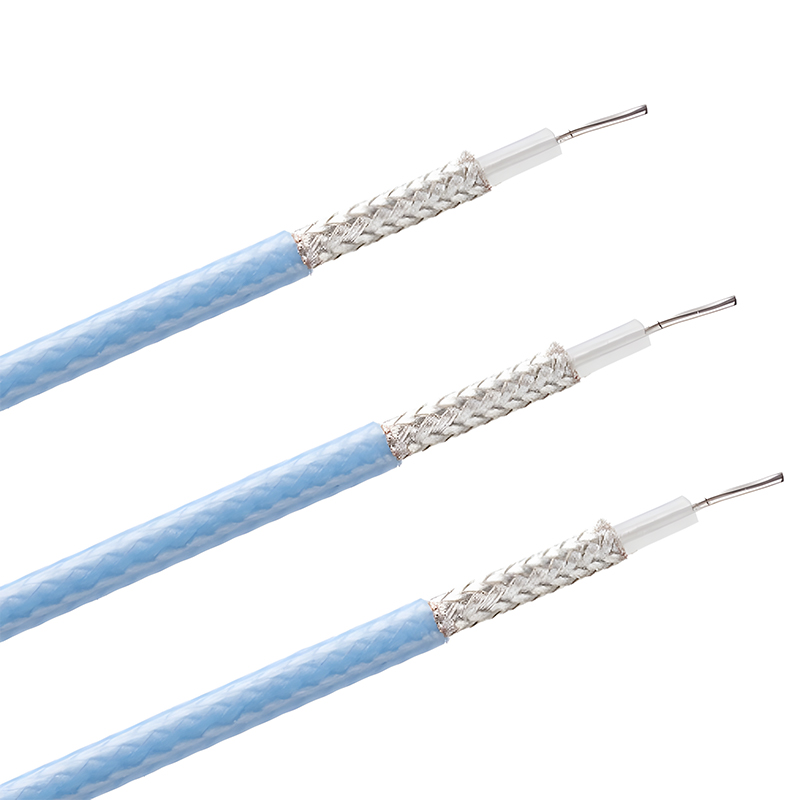 Custom RG-316 High-Temperature Coaxial (RF) Cable Manufacturer, Supplier - JiangJiangsu Silver & Tin Thread Hi-temperature Wire and Cables Co., Ltd. is China custom RG-316 High-Temperature Coaxial (RF) Cable suppliers...View Product →
Shielding Coverage and Construction
A standard single braid typically covers 90 to 95 percent of the cable surface. Double-shielded constructions add a second braid or a foil layer; the extra cost is justified when the cable runs near switching power supplies or antenna outputs.
Attenuation at the Operating Frequency
Do not compare cables by DC resistance alone. Request attenuation expressed in dB per meter at the frequencies your system actually uses, typically 1 GHz, 2.4 GHz, or higher. That single number determines the link loss budget more than any other spec.
Certifications That Separate a Cable Factory from a Trading Company
Every factory can claim to make coaxial cable. The certifications on the wall determine whether it can hold tolerances across a full production batch and keep records when something goes wrong.
- ISO9001 is the baseline quality management system. Treat it as the minimum entry condition, not a differentiator.
- IATF16949 signals that the factory has met automotive-sector quality requirements, which usually means stricter change control and batch traceability.
- UL and CE product certifications show that specific cable constructions have passed independent testing against defined safety and performance standards.
- RoHS and REACH compliance matters for electronics assembled in the European Union and for global brands that export finished equipment.
- For defense and aerospace buyers, a military-grade quality management system is a practical filter when sourcing precision RF cable.
Ask for type test reports, material certificates for the copper and fluoroplastic compounds, and batch-level test records. A reliable manufacturer shares these documents without hesitation.
Where China-Made Coaxial Cable Is Actually Used
RF coaxial cable from Chinese manufacturers ends up in equipment that needs predictable signal integrity in tight spaces and hot environments. The main demand clusters are telecom base stations and antenna feeders, avionics and radar systems, automotive sensors and telematics modules, and industrial machinery with moving cabling.
Telecom projects require consistent impedance across long feeder runs and often demand flame-retardant jacketing. Those requirements are reflected in the telecom industry cable applications documented in real installation cases. Industrial equipment, by contrast, exposes cables to bending, oil, and heat; that is why buyers working in industrial machinery environments push toward PTFE-dielectric constructions instead of PVC types.
Two data points help engineers compare designs at the early stage: attenuation at the operating frequency and the balance of applications across industries.
Typical Attenuation at 1 GHz (dB per meter)
Illustrative values from typical data sheets; confirm with the factory's measured test data before ordering.
Common Incoming Inspection Issues and a Practical Procurement Checklist
When imported coaxial cable fails incoming inspection, the causes follow a fairly stable pattern. Awareness of this distribution helps buyers spend their audit effort where it pays off.
Typical Quality Issues Found in Incoming Inspection
- Impedance mismatch — 38%
- Insulation damage — 24%
- Braid coverage defects — 20%
- Connector transition issues — 12%
- Shipping and handling damage — 6%
Illustrative distribution compiled from common field reports; actual ratios vary by supplier and packaging quality.
Work through these steps in order. Skipping step three is the most common reason buyers discover a problem only after the container arrives.
- Lock the electrical envelope. Write down impedance, frequency range, attenuation budget, and maximum VSWR.
- Match the construction to the environment. Choose the dielectric, conductor plating, and shielding according to temperature, flexing, and EMC exposure.
- Request data sheets and type test reports before asking for price. If the factory cannot produce a data sheet with measured attenuation values, treat that as a red flag.
- Order samples and measure them yourself. Check impedance with a network analyzer and verify length markings and packaging quality.
- Audit the quality system. Confirm ISO9001 or IATF16949 certificates are current and actually cover the plant that will produce your order.
- Define packaging and traceability. Specify kink-resistant coils, labeling, and batch traceability so that a field failure can be traced back to production records.
Following this sequence does not guarantee a flawless project, but it eliminates the majority of preventable failures and gives both sides a clear, documented basis for acceptance.
Frequently Asked Questions
What is the difference between RG178 and RG316 coaxial cable?
Both are 50 Ω PTFE-dielectric cables rated for high-temperature service. RG178 has a smaller overall diameter and suits short internal jumpers where space is tight. RG316 uses a stranded center conductor, which provides better resistance to repeated flexing. Choose RG316 when the cable moves or bends in service.
Can Chinese manufacturers produce custom coaxial cable?
Yes. Factories with in-house extrusion and braiding can adjust conductor stranding, dielectric thickness, shielding layers, and jacket color. Custom work usually requires a larger minimum order and a longer lead time because new tooling or process settings may be needed.
What certifications should a coaxial cable supplier hold?
At minimum, ISO9001 for quality management and RoHS for material compliance. Automotive supply chains expect IATF16949. For UL-listed cable, verify the UL style number on the data sheet so the certification can be checked independently.
What is a typical minimum order quantity for coaxial cable from China?
For standard RG-series cable, factories often accept orders starting around 300 to 500 meters. Non-standard constructions may require 1,000 meters or more because the factory needs to qualify a new production setup.

-
Phone
+86-(0)21-6083 5889
+86 138 1238 0261 -
Email
export03@silvertincable.com
export@silvertincable.com -
Headquarter Address:
No. 20 Jianling Road, Zhangguo Community, Dainan Town, Xinghua City. Jiangsu Province China
-
Shanghai Branch:
Room 18A, West Building, Keji Jingcheng, No. 668 East Beijing Road. Huangpu District, Shanghai, China
Copyright © 2025 Jiangsu Silver& Tin Thread Hi-temperature Wire and Cables Co., Ltd. All Rights Reserved.
China industrial cable manufacturer Custom specialized wire & cable supplier