
 English
 русский
 Español
 عربى
عربى


Industry News
Is the heat constant, or does it cycle up and down?
2026-06-12
Content
- 1 Why the Heat Pattern Matters More Than the Number
- 2 What Thermal Cycling Actually Does to a Cable
- 3 Constant Heat: What Cable Construction Works Best
- 4 Cyclic Heat: Where Cable Selection Gets More Demanding
- 5 Key Questions to Ask Before Specifying a Cable
- 6 Conductor Material: An Underrated Variable in Thermal Cycling
- 7 Practical Guidance: Matching Cable to Heat Profile
- 8 The Bottom Line for Cable Buyers
The short answer: it depends entirely on your application — and this distinction is one of the most critical factors in selecting the right high-temperature cable. Constant heat and cyclic (up-and-down) heat expose cables to fundamentally different stress mechanisms. Choosing a cable matched only to peak temperature without accounting for thermal cycling patterns is one of the most common — and most costly — engineering mistakes in cable selection.
Why the Heat Pattern Matters More Than the Number
When engineers see a temperature rating on a cable datasheet — say, 200°C or 260°C — they often treat it as the primary specification. But the rated temperature alone tells only half the story. The thermal profile of your process, specifically whether the temperature is steady or repeatedly rises and falls, determines how that cable ages, flexes, and ultimately fails.
In constant-heat environments such as industrial ovens, kilns, or furnaces running at sustained output, a cable reaches thermal equilibrium and stays there. The insulation expands uniformly and remains under a consistent mechanical state. In contrast, cyclic applications — batch processing equipment, automotive test chambers, electric vehicle battery systems, and seasonal heating infrastructure — put cable materials through repeated expansion and contraction cycles. Each cycle introduces thermomechanical stress at every interface: conductor-to-insulation, insulation-to-jacket, and jacket-to-termination.
What Thermal Cycling Actually Does to a Cable
The physical damage from repeated heating and cooling is well-documented in materials engineering. When two bonded materials have different coefficients of thermal expansion (CTE), every temperature swing generates shear stress at their interface. Over hundreds or thousands of cycles, this produces fatigue failures — cracks in insulation layers, loosening of crimped terminations, and delamination of braided outer sheaths.
Three specific failure modes are most common in cyclic environments:
| Failure Mode | Root Cause | Typical First Sign |
|---|---|---|
| Insulation cracking | CTE mismatch between conductor and insulation polymer | Increased leakage current, reduced dielectric strength |
| Termination loosening | Creep and relaxation of fluoropolymer under compression | Increased contact resistance at connectors |
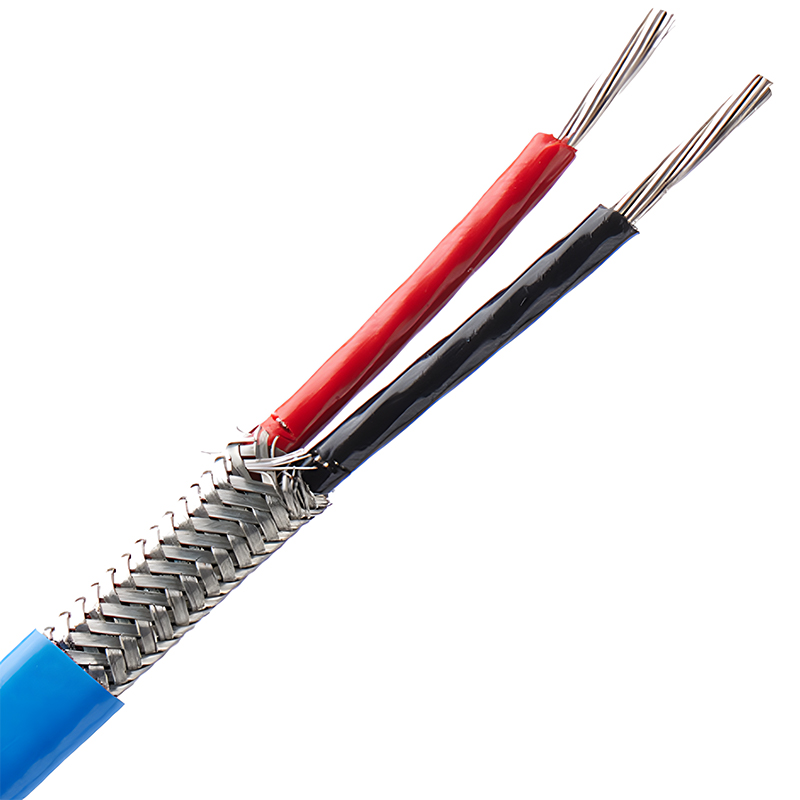
| Braid delamination | Differential expansion between fiberglass braid and inner jacket | Visible fraying, reduced mechanical protection |
Research comparing constant high-temperature dwell (80–120°C) against thermal cycling (80–140°C) found that the effective activation energy for damage under cycling was approximately 1.3 eV — more than double the 0.62 eV observed under steady heat. This means cyclic thermal stress drives failure mechanisms that are physically distinct from, and generally more aggressive than, those driven by static elevated temperature alone.
Constant Heat: What Cable Construction Works Best
Applications with stable, sustained high temperatures — ceramic tunnel kilns, continuous process heaters, transformer internal wiring — demand cables optimized for long-term thermal endurance rather than mechanical fatigue resistance.
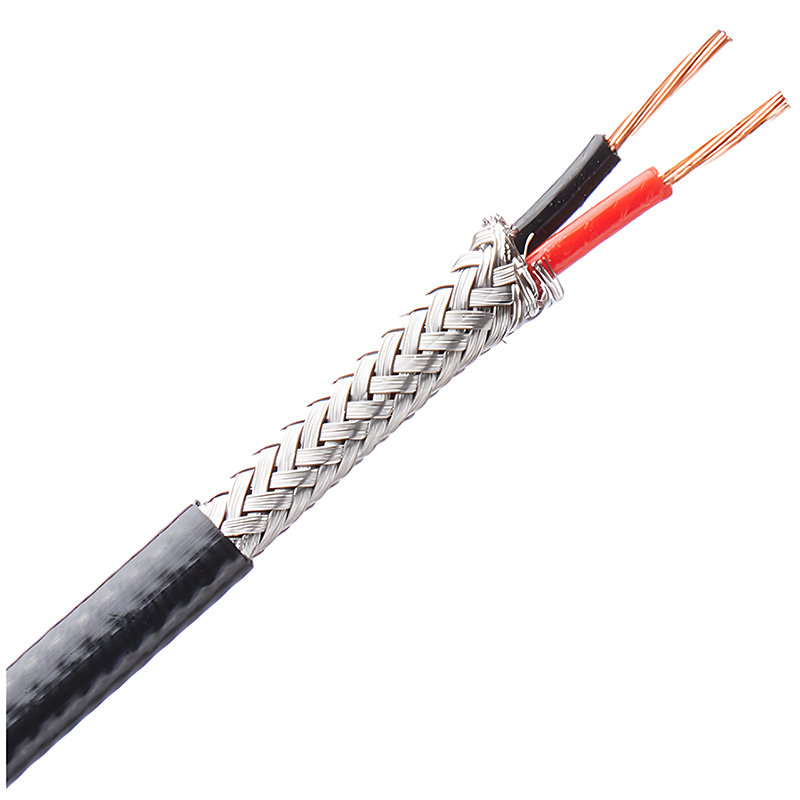
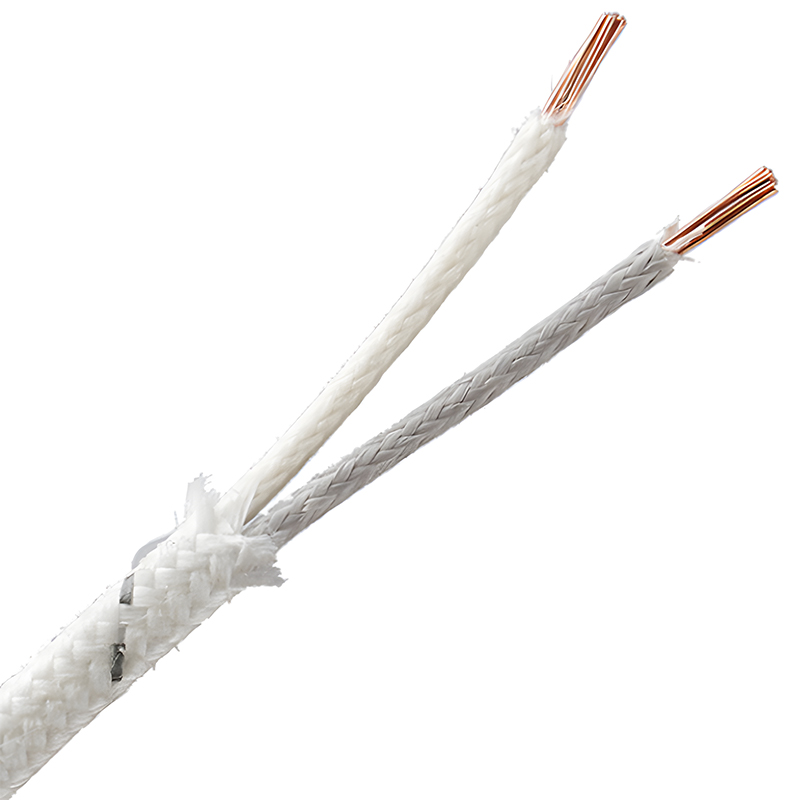
For continuous operating temperatures up to 260°C, PTFE (polytetrafluoroethylene) insulation is the standard engineering choice. Its operating range spans -200°C to +260°C, it exhibits outstanding chemical resistance, and its dielectric properties remain stable under sustained heat. For environments exceeding 260°C and up to 450°C or beyond, mineral-insulated cables and mica-glass composite constructions (such as MG wire with fiberglass braid jackets) are the appropriate solution — rated for continuous use up to 450°C and capable of brief exposure to 538°C.
| Temperature Range | Recommended Insulation | Typical Applications |
|---|---|---|
| 150°C – 200°C | Silicone rubber, SRML | Motor leads, appliance wiring, industrial ovens |
| 200°C – 260°C | PTFE, FEP, PFA | Sensors, chemical process heaters, aerospace |
| 260°C – 450°C+ | Mica-glass composite, fiberglass braid | Arc furnaces, cement kilns, smelters |
Cyclic Heat: Where Cable Selection Gets More Demanding
When your process cycles — heating up, then cooling down, repeatedly — the cable specification must prioritize mechanical fatigue resistance alongside thermal rating. This fundamentally changes the preferred materials.
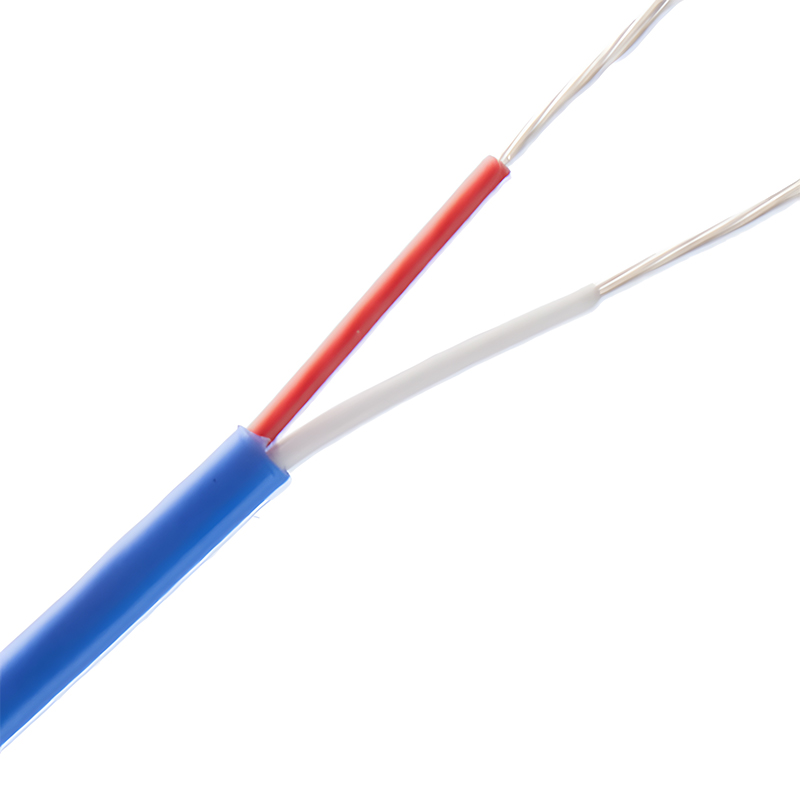
Silicone rubber insulation is the front-line choice for cyclic thermal environments. Its key engineering advantage is elastic recovery: silicone returns to its original dimensions after thermal expansion rather than accumulating permanent strain. This makes it highly tolerant of repeated temperature excursions. Silicone cables are widely used in industrial ovens that batch-process materials, automotive testing equipment, and moving machinery near heat sources — all environments where the temperature rises and falls with each operating cycle.
A critical but frequently overlooked issue involves PTFE cable terminations in cyclic applications. While PTFE itself handles thermal cycling well at the insulation level, its low-friction surface and susceptibility to "cold flow" (creep under compressive load) can cause standard crimped terminations to relax over repeated cycles. In cyclic applications with PTFE cables, calibrated termination tooling, strain relief, and periodic connection inspection are engineering requirements, not optional maintenance.
Key Questions to Ask Before Specifying a Cable
Whether procuring from a specialist manufacturer or reviewing a general datasheet, the following questions define the thermal profile that your cable specification must address:
- What is the continuous operating temperature? This is the baseline thermal rating required.
- What is the peak temperature, and for how long? Short-term excursions above rated temperature require a cable designed for thermal shock, not just sustained heat.
- How many thermal cycles per day, per month, per year? A cable seeing 50 cycles per day accumulates over 18,000 cycles annually — fatigue life becomes a primary selection criterion.
- What is the delta-T of each cycle? A swing from 20°C to 180°C (delta-T of 160°C) generates far greater thermomechanical stress than a swing from 100°C to 150°C (delta-T of 50°C).
- Are there simultaneous mechanical stresses? Vibration combined with thermal cycling accelerates fatigue failures significantly compared to thermal cycling alone.
Conductor Material: An Underrated Variable in Thermal Cycling
The conductor itself — not just the insulation — must be specified for the thermal environment. Standard bare copper conductors are adequate for many constant-heat applications. However, in cyclic environments, bare copper exposed to air at high temperatures develops an oxide layer that increases contact resistance over time. Tinned copper conductors provide oxidation resistance up to approximately 150°C. Silver-plated copper is the standard choice for high-cycle applications above 150°C, offering stable contact resistance through thousands of thermal cycles. Nickel-plated copper extends this capability further, remaining stable in environments up to 260°C with excellent oxidation resistance.
Practical Guidance: Matching Cable to Heat Profile
The table below summarizes the recommended approach based on the two dominant heat patterns found in industrial applications.
| Heat Pattern | Priority in Cable Selection | Preferred Construction | Watch Out For |
|---|---|---|---|
| Constant / Steady | Thermal endurance rating, chemical stability | PTFE, PFA, mica-glass composite | Peak temperature excursions during startup |
| Cyclic / Up-Down | Fatigue life, elastic recovery, termination integrity | Silicone rubber, flexible fluoropolymer constructions | Cold-flow creep at terminations; accumulated fatigue over thousands of cycles |
When the heat profile is mixed — constant at elevated temperature with periodic excursions — specify the cable for the cyclic stress case. Overspecifying for fatigue resistance adds marginal cost; underspecifying for it risks premature failure and unplanned downtime.
The Bottom Line for Cable Buyers
A temperature rating on a cable is a starting point, not a complete specification. Before finalizing any high-temperature cable selection, define whether the heat in your application is constant or cyclic, quantify the temperature swing and cycle frequency, and verify that the cable's insulation material, conductor plating, and termination design are all matched to that profile. For specialist industrial environments — glass plants, forging operations, steel facilities, automotive test rigs — consulting directly with an experienced high-temperature cable manufacturer and providing them with a full thermal profile is the most reliable path to a cable that performs as expected across its service life.

-
Phone
+86-(0)21-6083 5889
+86 138 1238 0261 -
Email
export03@silvertincable.com
export@silvertincable.com -
Headquarter Address:
No. 20 Jianling Road, Zhangguo Community, Dainan Town, Xinghua City. Jiangsu Province China
-
Shanghai Branch:
Room 18A, West Building, Keji Jingcheng, No. 668 East Beijing Road. Huangpu District, Shanghai, China
Copyright © 2025 Jiangsu Silver& Tin Thread Hi-temperature Wire and Cables Co., Ltd. All Rights Reserved.
China industrial cable manufacturer Custom specialized wire & cable supplier